
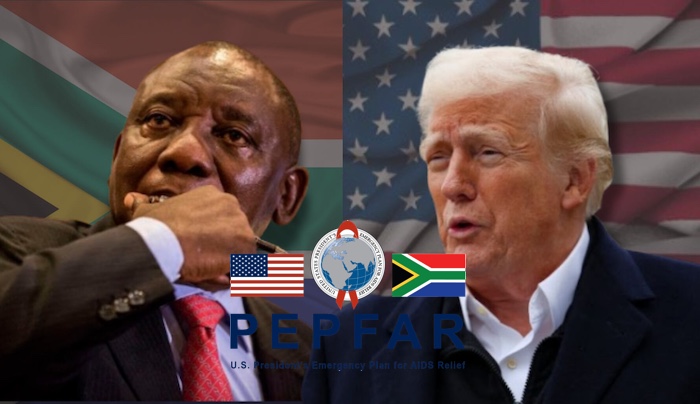
US Ends HIV Funding for South Africa Amid Policy Row
The United States government has announced it will end funding for HIV and Aids programmes in South Africa, a decision that could have devastating consequences for one of the world’s most affected countries. More than eight million South Africans are living with HIV — the highest number of any country in the world.
The US State Department linked the decision to South Africa’s alleged failure to protect the white-minority Afrikaner community, an accusation the South African government has repeatedly rejected. The decision marks a significant escalation in tensions between the two countries, which have been strained since the return of President Donald Trump to office.
A History of Tensions
Until 2025, the US was supporting South Africa’s HIV efforts with an estimated $400 million annually through the President’s Emergency Fund for Aids Relief (PEPFAR). However, relations between the two countries have soured since Trump’s inauguration. Shortly after taking office, he issued an executive order alleging that South African policies dismantled equal opportunities and fuelled violence “against racially disfavored landowners.” The order also cited South Africa’s case against Israel at the International Court of Justice and its links to Iran.
The Trump administration has also falsely alleged that there is a “white genocide” taking place in South Africa — a claim widely discredited by human rights organizations and international observers. This led to the establishment of a refugee programme for Afrikaners, who are now among the few refugees being allowed into the US. The genocide claim has been repeatedly rejected by the South African government, which points to its Black Economic Empowerment (BEE) policies as necessary measures to correct the deep economic inequalities inherited from the apartheid era.
Read Also: 42 South Africans Deported from Ireland on Chartered Flight
The Impact on HIV Response
PEPFAR funding had been providing about a fifth of South Africa’s total spending on HIV programmes. A “bridge plan” secured a temporary reprieve last October, but a US State Department official has now confirmed a “phased drawdown” of funding will begin. The official cited South Africa’s “failure to make demonstrable progress on policy requests by the administration.”
The US government stated its intention was to “foster self-reliance” and reduce dependency on American funding, pointing out that “South Africa is a middle-income country and is more than capable of supporting its own health programs.” However, PEPFAR has been credited with saving more than 25 million lives globally since its inception in 2003, and the decision to withdraw from South Africa — the country with the world’s largest HIV burden — has been met with alarm from public health experts.
South Africa’s Response
South Africa’s health ministry responded by saying that though it had not been informed of the decision, it had “long been working on a self-reliance plan.” The ministry also noted that while PEPFAR contributed to the country’s HIV programme, the provision of life-saving antiretroviral drugs was funded separately, with most funding coming from the government.
However, experts have warned that the loss of PEPFAR funding could disrupt prevention programmes, including testing, education, and support for vulnerable populations such as sex workers and young women.
Failed Attempts at Repair
Attempts to mend US-South Africa relations have floundered. A high-profile White House meeting between Trump and President Cyril Ramaphosa over a year ago failed to resolve tensions, with Trump confronting his counterpart with his claims of white persecution.
The US also boycotted the G20 meeting hosted by South Africa last November, a significant diplomatic snub that further strained relations. The US has also expressed opposition to South Africa’s case against Israel at the ICJ and its growing ties with Iran and Russia, adding layers of geopolitical complexity to the dispute.
Our Perspective
The decision to end HIV funding is about more than money — it reflects a broader geopolitical shift in which health aid is being weaponized for diplomatic leverage. For South Africa, the challenge is not just managing the loss of funding but also navigating a relationship with a superpower that has increasingly framed its policies in terms of racial grievance.
The real question is whether other international partners — including the European Union, China, and the African Union — will step in to fill the gap. The withdrawal also raises troubling questions about the future of global health cooperation, where the needs of millions can be suspended over political disputes. The African Union has expressed solidarity with South Africa, with some member states calling for a coordinated African response to the funding cut. For now, the South African government and its health system face a moment of reckoning: can they chart a path to self-reliance without sacrificing the health and lives of millions?