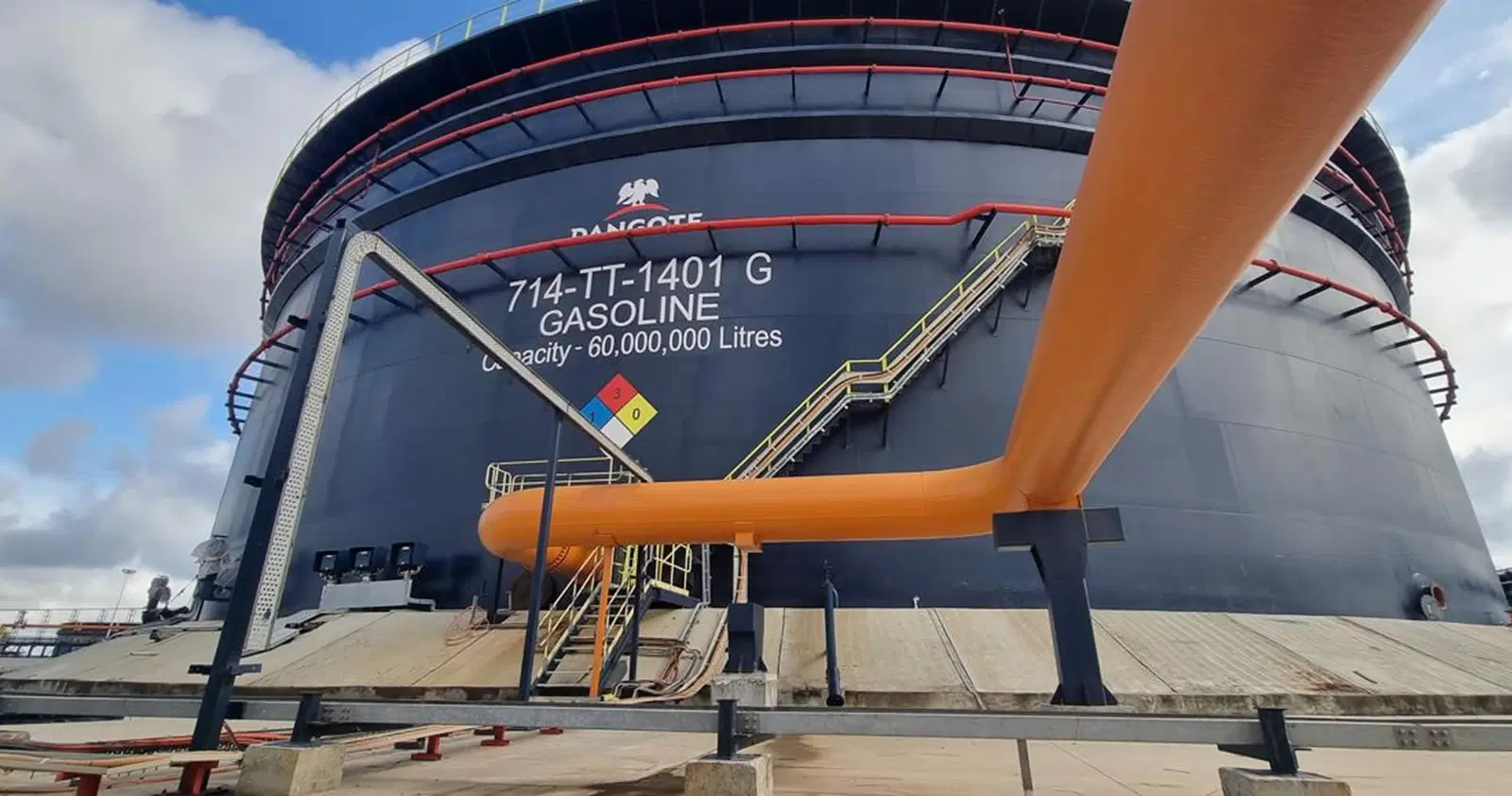
In a landmark deal for African energy, Dangote Petroleum Refinery and Petrochemicals (DPRP) has successfully raised $2.5 billion through a private equity placement, marking the continent’s largest publicly disclosed primary equity private placement by value. The offering was 3.7 times oversubscribed, signaling deep investor confidence in the refinery’s expansion strategy .
A Game-Changer for African Energy
The investment comes as the Dangote Refinery, already operating at 650,000 barrels per day (bpd) near Lagos, Nigeria, is transforming fuel dynamics across West Africa. Since commencing operations, the refinery has significantly reduced Nigeria’s dependence on imported fuel and turned the country into a net exporter of diesel, jet fuel, and naphtha.
The refinery’s impact on regional fuel trade has been immediate and profound. According to industry data, West African imports of refined petroleum products from outside the region fell by almost 25% year-on-year in the second quarter of 2026, a decline attributed directly to the Dangote Refinery’s ramp-up in production. Jet fuel exports from Nigeria to European markets have reached record levels, with nearly half of all product loadings from the refinery comprising jet fuel in June 2026 . The facility is also producing enough diesel and gasoline to meet a substantial portion of Nigeria’s domestic needs, reducing the country’s import bill and conserving foreign exchange reserves.
“The successful completion of this landmark fundraising demonstrates investors’ confidence in our expansion strategy,” said Aliko Dangote, Chairman of DPRP. “It also reflects our commitment to strengthening Africa’s refining capacity, reducing dependence on imported petroleum products and enhancing the continent’s energy security.”
Key Investment Highlights
| Metric | Detail |
|---|---|
| Total Raised | $2.5 billion |
| Oversubscription | 3.7x |
| Key Investors | Africa Finance Corporation (AFC), Afreximbank (via India Infra Buildco), sovereign wealth funds, institutional investors |
| Current Capacity | 650,000 bpd (operating at 700,000 bpd after debottlenecking) |
| Expansion Target | 1.4–1.45 million bpd by 2028 |
| Valuation | ~$39–40 billion |
Who Invested and Why
The $2.5 billion private placement attracted a diverse group of investors, reflecting broad international confidence in the project:
-
Africa Finance Corporation (AFC) – A leading pan-African multilateral development finance institution focused on infrastructure and industrial development. AFC’s involvement demonstrates the project’s significance to Africa’s economic transformation agenda.
-
Afreximbank (via India Infra Buildco) – The African Export-Import Bank, through its infrastructure investment vehicle, is supporting the expansion of refining capacity to reduce the continent’s import dependence.
-
Sovereign wealth funds and institutional investors – A range of sovereign wealth funds and institutional investors participated in the oversubscribed offering, signaling confidence in the refinery’s long-term commercial viability and strategic importance.
The offering was 3.7 times oversubscribed, meaning that demand far exceeded the shares available. This suggests a strong pipeline of future investment interest that could support additional expansions or IPOs . Valuation estimates for the refinery currently stand at approximately $39–40 billion, positioning it as one of the most valuable industrial assets on the continent.
Read More: World Public Summit Africa & “Unity” Art Exhibition: A New Era for African Diplomacy
Expansion Plans: Creating the World’s Largest Refinery
The new funding will support Dangote’s ambitious expansion to more than double the Lekki complex’s capacity to 1.4 million bpd by 2028. If completed, it would become the world’s largest refinery, surpassing Reliance Industries’ Jamnagar complex in India, which currently has a capacity of approximately 1.24 million bpd. The expansion timeline is ambitious, but the company has already taken concrete steps toward this goal by securing long-term engineering, procurement, and construction contracts with a consortium of international firms.
The proposed expansion includes:
-
A new 750,000 bpd crude distillation unit
-
Increased polypropylene production to 2.4 million tonnes per year
-
New output of base oils and linear alkylbenzene feedstocks
-
Upgraded fuel output to Euro 6-quality standards
-
Enhanced on-site power generation for operational self-reliance
David Bird, Managing Director and CEO of DPRP, noted: “The exceptional demand we witnessed is a testament to our operational excellence, execution capability and the confidence investors have in DPRP’s leadership and future potential.”
The Technology Behind the Expansion
The refinery is designed to process a wide range of crude types, including the light, sweet crude produced in Nigeria and heavier crudes imported from other regions. This flexibility allows the facility to optimize its feedstock based on global market conditions, a key competitive advantage.
The expansion will incorporate cutting-edge refining technologies, including:
-
Advanced hydroprocessing units to produce higher-quality, lower-sulphur fuels that meet stringent environmental standards in Europe and North America
-
Catalytic cracking and reforming units to maximize the yield of high-value products like gasoline and petrochemical feedstocks
-
Integrated cogeneration facilities to improve energy efficiency and reduce operational costs
-
Digital control systems using artificial intelligence and machine learning to optimise process operations and reduce downtime
These technological capabilities position the Dangote Refinery to compete effectively with the world’s most advanced refining complexes.
A Broader Pan-African Strategy
Dangote’s vision extends beyond Nigeria. The group aims to increase its total refining capacity to 2.1 million bpd by expanding in Nigeria and building a new 700,000 bpd refinery in Kenya to serve East African markets. This strategic expansion would create a pan-African refining network that reduces the continent’s dependence on imported fuel across multiple regions.
The group plans to invest $46 billion between 2026 and 2028 across its refining, cement, and fertiliser businesses, a massive industrial transformation program that would reshape Africa’s industrial landscape. This investment represents one of the largest single corporate investment programs ever undertaken on the continent.
Strategic Rationale: Why Africa Needs Refining Capacity
Industry stakeholders view these investments as a significant step towards reshaping Africa’s energy landscape. The African Petroleum Producers’ Organisation notes that Africa exports about three-quarters of its crude oil while importing roughly 70% of the refined products it consumes. This imbalance means that the continent loses significant value by exporting raw crude and re-importing refined products, a pattern that experts have described as “economic colonialism.”
Expanding local refining capacity is expected to:
-
Retain more value within African economies
-
Conserve foreign exchange that would otherwise be spent on fuel imports
-
Create thousands of direct and indirect jobs across the value chain
-
Reduce exposure to global market volatility
-
Enhance energy security and reduce geopolitical dependence on external suppliers
The Dangote Refinery’s expansion is a key component of this broader continental strategy, demonstrating that large-scale industrial projects can be successfully developed and financed in Africa.
What This Means for Africa
The refinery’s impact on regional fuel trade has already been transformative:
-
West African imports of clean products from outside the region fell by almost 25% year-on-year in Q2 2026
-
Jet fuel exports to Europe reached record levels, with nearly half of product loadings in June comprising jet fuel
-
The refinery is helping cut dependence on external suppliers and positioning Nigeria as a key exporter to neighbouring African markets
However, challenges remain. Crude supply has not always met the refinery’s needs, with domestic supply peaking near 650,000 bpd in May before easing. Distribution infrastructure—including limited storage, heavy reliance on road transport, and high inland transit costs—also presents obstacles to the refinery’s pan-African vision.
Challenges and Risks
Despite its achievements, the Dangote Refinery faces several challenges:
-
Crude supply instability: The Nigerian government has committed to allocating 450,000 bpd of domestic crude to the refinery, but actual deliveries have been inconsistent. The refinery has had to supplement domestic supplies with imports from other producers, adding cost and complexity.
-
Infrastructure constraints: Port facilities, pipeline capacity, and road networks in Nigeria struggle to handle the volume of crude inputs and product outputs. The lack of a dedicated pipeline network linking the refinery to major consumption centres remains a significant logistical challenge.
-
Regional competition: Other refineries are planned or under construction across Africa, which could eventually compete for market share. Ghana, Angola, and Côte d’Ivoire have all announced plans to expand or build new refining capacity.
-
Global energy transition: The long-term outlook for oil demand is uncertain as the world shifts toward renewable energy and electric vehicles. The refinery’s ability to produce higher-value petrochemicals and feedstocks could reduce its exposure to declining fuel demand.
-
Cost overruns and delays: Large industrial projects in Africa often face cost overruns and schedule delays. Maintaining the $46 billion investment program’s timeline will require careful management and consistent capital availability.
The AfricanaWeb Perspective
The Dangote Refinery’s $2.5 billion capital raise is more than a corporate milestone—it’s a statement of African industrial ambition. At a time when the continent imports most of its refined fuel despite abundant crude reserves, this investment signals a shift toward energy sovereignty.
The refinery’s expansion demonstrates that Africa can finance, build, and operate world-class industrial infrastructure. As Aliko Dangote himself said: “We are for Africa, not just Nigeria.” This vision—of a continent that processes its own resources, creates its own jobs, and reduces its dependence on external suppliers—is exactly the kind of transformative development that AfricanaWeb exists to document.
The road ahead is long, and the 2028 expansion timeline may be ambitious. But the direction is clear: Africa is building its own energy future. The Dangote Refinery is not just a Nigerian project; it is a continental one, representing a model for how African nations can work together to build the infrastructure they need for sustainable development and economic sovereignty.